|
Gulf Air Bahrain Grand Prix
Click here for a large map of the circuit
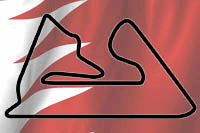
From a driver perspective
The Bahrain circuit is a real challenge: particularly for the tyres in terms of overheating. Quite often you get sand blowing onto the track, which is one of the unique features of this circuit and throws another challenge into the mix. A dusty track will have less grip than a clean one, so you have to prepare for that to change even between qualifying sessions.
The layout has a great combination of fast, slow and medium corners which make it tough for the drivers and the car. The lap starts with a long, DRS-enabled straight heading into the first corner. This is very tight right-hander, changing down to first or second gear before immediately shifting up again as you head immediately into Turns 2 and 3.
After the second of four straights, Turn 4 requires quite heavy braking and can catch you out on the exit. As you clip the apex the track starts to drop away from you and it can be quite tricky to stop the car from sliding wide. After the downhill section of Turns 5, 6, 7 and 8, you rise up again briefly before a tricky slope down through Turns 9 and 10. These are off camber and it's easy to lock the inside wheel as the curve gets tighter and tighter.
The third straight comes next, with a second DRS zone making the following corner at Turn 11 one of the best overtaking opportunities around the track. This is a flowing curve which switches back into the right-hander at Turn 12. You try to take this flat out before braking into Turn 13. You need a late apex through this corner and it's essential to get that right, as it leads into the fourth and final straight of the lap. The same applies for the Turn 14 and 15 combination, which bring you back onto the home straight.
DRS Zones
As in 2023 there will be three DRS Zones.
The first features a detection point 50m before Turn 1, with activation 23m after Turn 3.
The second has a detection point 10m before Turn 9 and activation 50m after Turn 10.
The third zone has a detection point 110m before Turn 14, but activation is 170m after Turn 15.
Changes for 2025
The gravel bed at the exit of Turn 4 has been extended.
U-drains close to the racing line have been closed off with cement and relocated away from the white line into the run-off areas.
Repairs have been made to the bumps on the start-line straight and Turn 9.
From a power unit perspective
Sakhir sits in the middle of the table for power unit demands. The circuit includes four straights and the ICE and turbocharger will work at full revs for around 61% of the lap.
Bahrain's arid climate can have severe consequences for the ICE. Pressure inside the cylinder rises and knock can be a real problem. Ignition timing is therefore very tightly controlled and checked to prevent issues developing.
The corners of the back section from turns 4 to 8 and 11 to 13 have several heavy braking points. Around 29% of the energy recovered under braking comes from turns 1 and 4, which will allow the MGU-K to keep the battery reserve at high charge. This is very important since the MGU-K will also be required to feed the ICE on those four long straights.
The long straights give a steady stream of exhaust flow to the MGU-H. This is particularly important since fuel consumption over one lap is extremely high due to the frequency of heavy braking and acceleration. Sakhir has in fact the second highest fuel consumption per lap after Montreal.
The straights give plenty of opportunity for the MGU-H to recover energy from the exhaust, but it's crucial for it to convert quickly to the 'motor' function to give good drive out of the slow speed corners. A smooth, neutral PU set up will show up in the lap time.
The braking points at the end of the straights call for particular engine maps. Coming after a long period of wide open throttle, the braking phase is a lot heavier and cylinders are cut for longer. As a result their temperatures drop and getting them firing again correctly is incredibly important.
From a tyre perspective
It's just over eight thousand kilometres as the crow flies between the scenes of the third and fourth rounds of the 2025 season. From Japan and the historic Suzuka track surrounded by cherry blossom, Formula 1 is now setting up shop in the semi-desert archipelago of Bahrain in the Persian Gulf. A significant difference, especially in terms of temperature, given that it will go from a maximum of under 20°C and the rainy conditions of last Sunday morning to predicted highs of around 30 °C for this coming weekend.
In fact, temperature will be a very important variable when it comes to tyre management at the fourth race of the year. As was the case in Suzuka, the teams will have a choice of the three hardest compounds in Pirelli's 2025 range, namely the C1 as Hard, the C2 as Medium and the C3 as Soft. However, the Sakhir track characteristics and indeed the temperatures, will require a different approach to that adopted last week in Japan.
In fact, all the teams will have a good baseline from which to start work, given that in the last week of February, the Sakhir circuit hosted the only pre-season test as per the 2025 sporting regulations. It means that everyone will have plenty of data to work with when it comes to setting up the cars and choosing the best strategies for qualifying and the race.
Over 24 hours of track time, the 20 drivers racked up 3,897 laps, equivalent to 21,090.564 kilometres and the tyres to be used this weekend did the most work back then: the C3 did the lion's share, completing 67.17% of the laps, followed by the C2 (20.88%) and the C1 (9.26%). There were a measly 104 laps run on the C4 and three on the Intermediate. However, this weekend's temperatures will present a new challenge, because during the test week, Sakhir saw unusual weather with strong winds leading to much cooler air and track temperatures than is normal at that time of year.
The minimum start pressures for this weekend have changed based on analysis of the test data, to 23 psi on the front and 21 at the rear. That represents an increase of +1 on the front axle and +2 on the rear compared to the 2024 race and of 0.5 psi on both axles compared to February's test.
If there's one Grand Prix where a two-stop strategy would seem to be a given, then it's Bahrain and that was the case last year, when it was the opening round of the season. All drivers made at least two stops, while some, like Hulkenberg (Haas) through force of circumstance, others by choice, Gasly (Alpine) and Sargeant (Williams) even stopped three times. Soft and Hard were the preferred compounds, with the vast majority opting to start on the C3 before making the most of the two sets of C1 they had saved specifically for the race. The exceptions were the Red Bull duo of Verstappen and Perez, who did the final stint on a set of C3s, down to the Milton Keynes team's technical superiority at the time, underlined by the fact they finished first and second. Their Racing Bulls sister team tried the same thing with Ricciardo, but he finished outside the top ten.
Based on what we have seen in winter testing and over the opening three rounds, it could be a different scenario because of modifications made to the compounds for 2025. While the C1 is pretty similar to its predecessor, the C2 and C3 are softer and most significantly, the three compounds have a better spread in terms of their performance delta. This could therefore bring the C2 back into play as a race tyre, thus creating more strategy choices for Sunday, with even a one-stop becoming a realistic possibility. Much will depend on how hotter it will be compared to the test, so the three hours of free practice will be very important, especially FP2, which takes place at a similar time of day to the early part of the race.
The Sakhir circuit boasts several layouts, with two different ones used for the races in 2010 and 2020, but the current one is 5.412 kilometres in length and features 15 corners, 9 to the right and 6 to the left. The track is one of the toughest on the calendar when it comes to tyres, especially in the braking areas and when traction is required. The aggregate used for the asphalt at the Bahrain International Circuit is still very abrasive, despite it being quite old now. The surface provides good grip for the tyres, although sand blown onto the track can be a nuisance. Wear is not usually a limiting factor, neither is graining, but thermal degradation, especially across the rear axle, has a significant impact on tyre performance. Managing that is the key to getting a good result. Overtaking is possible, especially under heavy braking at turns 1, 4 and 11.
Keyword: Degradation
There are two types of degradation, one that affects the tyre surface and the other that impacts the chemical bonding of the materials that make up the tread.
The first, which we simply call overheating, is generated when the tyre surface slides excessively on the track. In this case, the surface temperature increases and the tyre loses grip. The phenomenon can be reversed by a change of driving style or if the weather conditions change.
As for thermal degradation, that occurs when the amount of energy exerted on the tyre is high enough to generate heat capable of altering the chemical bonds of the tread and in this case, the loss of grip is irreversible.
These two phenomena are not entirely independent of one another.
Both types of degradation lead to a loss of tyre performance and if a driver sees his is greater than that experienced by other drivers close by, then it might be time to change tyres for a new or part-worn set. The original set has come to the end of its performance life in terms of how many laps it can run before it should be changed as the tyres can no longer deliver a competitive level of performance. Wear life is the maximum number of laps that a tyre can cover before the tread surface has completely worn away.
There have been 20 editions of the Bahrain Grand Prix, the first dating back to 2004, won by Michael Schumacher in a Ferrari. It was the very first Formula 1 World Championship race to be held in the Middle East. In 2020, Bahrain hosted two races on consecutive weekends, the first on a shorter 3.534 kilometre track with just 11 corners, which was called the Sakhir Grand Prix. As previously mentioned, the 2010 race was run over a 6.229 kilometre layout.
The most successful driver in Bahrain is Lewis Hamilton with five wins. Of the drivers racing this year, Fernando Alonso has won 3, Max Verstappen (2) and Charles Leclerc (1). Sebastian Vettel, Hamilton and Verstappen all share the record for pole positions with three, while the English driver on 11, has the most podium finishes to his name. Of the teams, Ferrari leads the way with seven wins, and podium finishes (17), while Mercedes on seven has the most pole positions.
Fast Facts - Provided by Mercedes
• Located in the middle of the desert, on what was formerly a camel farm, the Bahrain International Circuit features 1,120 palm trees.
• Being situated in a desert, you may expect sand to be an issue. However, the surrounding desert is sprayed with a sticky adhesive substance to minimize the amount of sand blowing on to the track.
• From the first breaking of the ground to build the Bahrain International Circuit to completion took just 496 days.
• The total run-off area is 140,000 sq. metres.
• The Bahrain International Circuit has five FIA certified track layouts.
• Focus for car set-up is on optimising low and medium-speed corner performance. Mechanical grip is crucial out of the slower corners, whilst the high-speed sections are easily taken flat-out.
• This will be F1's second visit to Bahrain in 2025, after the official three-day pre-season test in February.
• The track surface is made from a special aggregate that was shipped from a quarry in England.
• A few adjustments to the circuit have been made for 2025: the gravel bed at the exit of turn four has been extended, U-drains close to the racing line have been closed off and moved away into the run-off areas, and bumps at the start/finish straight and turn nine have been repaired.
• Bahrain has hosted the opening round of the F1 season on six occasions.
• Four different layouts have been used to host the F1 Grands Prix over the years.
• George Russell made his debut for the team in Bahrain at the 2020 Sakhir Grand Prix.
• Mercedes has won six times in Bahrain.
• Mercedes' first race back as a works team in F1 was in Bahrain at the start of the 2010 season.
• Fred Vesti will undertake the first of two compulsory FP1 sessions George must vacate his seat for this season. It will be the third rookie session for Fred after Mexico and Abu Dhabi in 2023.
• Fred's compatriot and team Junior Driver Noah Strømsted will be in FIA Formula 3 action over the weekend.
• The race lap record of 1:31:447 in Bahrain was set by a Mercedes Benz power unit, all the way back in 2005 by Pedro de la Rosa's McLaren.
|