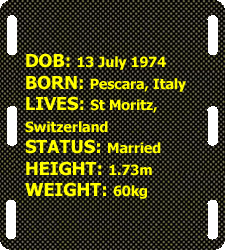
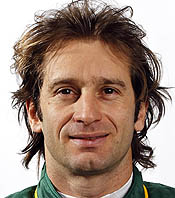
|
After winning a number of karting championships in his youth, including the World Championship in the 100 FK class (1991), and finishing runner up in 125 FC (1992) and 100 SA (1993), Jarno Trulli eventually switched to German F3, with a little help from manager Flavio Briatore. He demonstrated his talent straight away and went on to win the 1996 German F3 Championship.
The promising Italian was signed to Minardi for 1997, making his F1 debut for the team in Melbourne. He switched to Prost mid-way through the season, replacing the injured Olivier Panis, and scored his first points in his third race for the team, bringing the car home fourth in the German GP.
Trulli stayed with Alain Prost's outfit for a further two seasons, and made his first trip to the podium at the Nurburgring in 1999 after finishing second.
After moving to Jordan for 2000, Trulli was disappointed to find the team plagued by mechanical problems, but some strong drives saw him finish in the points four times during his first year with the team and he stayed with them for the following season.
In 2001 Jarno was again a regular points scorer, but life at Jordan was far from easy, especially following the departure of the Italian's teammate Heinz-Harald Frentzen mid way through the season. Although he had stated his desire to stay with Eddie Jordan for another year, Trulli was called back to Renault by Briatore, and lined up alongside Jenson Button for 2002.
The new wide-angle V10 Renault showed much promise during pre-season testing and in the opening rounds of the championship. Unfortunately as the season progressed the French outfit didn't appear to find any extra power and consequently found it difficult to compete with the big players.
That said, the reliability problems that plagued Jarno in the early races seemed to have been resolved by mid-season and as a result the Italian was able to collect nine useful points, not easy when you consider the reliability of the Ferraris and WilliamsF1s.
In the post-qualifying press release issued by Renault in Japan - the last race of the 2003 season - Pat Symonds, the team's executive director of engineering - described the Italian as 'the unluckiest man in Formula 1', which just about sums up Jarno's season.
At least, certainly compared to 2002, the car went the distance more often than not, but on the whole the Italian's season can be summed up with those two little words 'bad' and 'luck'.
Japan was a good example, fastest in every session, clearly the pace setter, then just as he went out to begin his 'hot lap' in qualifying the heavens opened and a result he was forced to start from the back of the grid. That said, a strong, typically determined, drive saw him finish fifth.
In 2003, much of the attention was focussed on teammate Alonso this year, but Jarno put in some stirring drives, until 'Lady Luck' decided it was time to intervene. Eighth place in the drivers' championship for the second successive season wasn't bad considering.
2004 was definitely a season mixed emotions. The high was a superb, and well deserved win at Monaco, while the low has to be the last corner lapse of concentration which cost him second place, and ultimately his seat with Renault.
During the early part of the season Jarno was sublime. living up to all the promise (hype?) of the early years, indeed he stole much of teammate Alonso's thunder.
However, after France it all appeared to go downhill. Certainly Renault appeared to have lost the momentum shown in the early races, but it was the behind the scenes politics where the damage was being done.
As the relationship deteriorated, Jarno did himself no favours by clearly going out of his way to antagonize his employers, but more importantly team principal Flavio Briatore. An uninspired performance would end with a super-fast lap, just to prove a point.
As the situation worsened the team finally decided that it had no option but to let the Italian go, therefore after Italy he and Renault parted company, followed, the day after, by the news that he had signed to Toyota for 2005. Having been released from the Renault contract Jarno was allowed to move to the Japanese team for the remainder of the season, the races in Japan and Brazil seeing him finish 11th and 12th respectively.
In 2005, much was expected of the Italian, named after the Finnish motorcycle-racing champion, Jarno Saarinen, who was killed at Monza in 1973.
The season got off to a dream start, when Jarno qualified on the front row in Melbourne, Unfortunately, following his first pit stop, the Italian encountered a problem with a rear tyre, which was to drop him down the field, eventually finishing ninth. Two weeks later however, having again qualified second, he maintained the position to give his employer its first ever podium result, adding another podium in Bahrain.
During the course of the season, Jarno was to deliver some devastating performance, sadly, almost al of them were during qualifying.
When it came to the race however, the Italian rarely appeared to match his qualifying pace, and more often than not ended up becoming a mobile chicane, leading what was to be (cruelly) known as the 'Trulli Train'.
Truth is, Jarno's qualifying performances usually flattered the TF105, however, there was a tendency for him to be flustered by minor (handling) problems and end up making a mountain out of a molehill.
Nonetheless, he gave Toyota its first two podiums, and its best finishes of the season, even though he finished two points down on his teammate, following a clear dip in performance towards the end of the year.
Retained for 2006, much was expected of the TF106 and the Italian. However, it was to be a difficult year for both parties.
After the success of 2005, and the not unreasonable claim that Toyota would score its maiden GP win, 2006 came as something of a shock, to put it mildly.
The entire TF106 and RVX-06 package was disappointing, with the TF106B - introduced at Monaco - proving only a little better. A lack of grunt from the Toyota powerplant, combined with a lack of balance and grip, meant that Trulli was never a serious contender, though were occasions when it appeared that someone had forgotten to tell the Italian.
As in 2005, Jarno was beaten in the Drivers' Championship by his German teammate, however, it was the Italian who usually looked more likely to pull of a surprise result.
While he had been a regular points scorer in the early stages of 2005 - remember the back-to-back runner up spots in Malaysia and Bahrain - it was Canada - round nine of the championship before he scored his first points in 2006. That said, there were some strong qualifying performances, even if the strategy was dubious.
The highlight of a poor season was at Monaco, scene of his magnificent victory in 2004, where he held third until succumbing to a hydraulics failure just a few laps from the finish. Then here was his in-house victory over Ralf at Suzuka, the Italian refusing to capitulate to the German.
At Hockenheim, it was announced that Jarno had signed a new three-year deal with Toyota, at a time when many believed the Italian was considering retiring.
Those expecting a significant improvement from Toyota in 2007 were to be disappointed. While the TF107, unlike its Honda counterpart, was not an absolute dog, it certainly wasn't good. The main problem was, and this is significant when talking about a fast driver such as Jarno, is that the TF107 lacked pace. Consequently, for much of the season it was about catching up with the opposition, a major problem when the car had been a let-down in qualifying.
The Italian out-qualified his teammate, Ralf Schumacher, fourteen times, however, all too often the car was unable to match its rivals race pace.
There were some notable performances, most notably in North America, coincidentally at a time when Ralf was under intense pressure from the team. Despite a number of upright failures Jarno gave his all in Canada, however, his efforts were totally compromised when the team, fearing another failure, ordered him to "avoid the kerbs". However, whilst on the other side of 'the pond' he picked up his best result of the season, a sixth at Indianapolis.
Retained for 2008, Jarno went into the new season as the fourth most experienced driver on the grid. However, those who were expecting the Italian to cruise, Ralf Schumacher style, towards retirement were in for a surprise, the former Kart World Champion giving a number of feisty performances.
For much of the season, the front end grip of the TF108 suited Jarno, the Italian able to give some remarkable performances in qualifying and the races. He also appeared to benefit from the recruitment of Frank Dernie who helped bring out the very best in a driver notoriously fussy about set-up.
There were a number of excellent qualifying performances, and while Brazil might stand out as a highlight, Malaysia, France and Germany were also very good.
In previous years we had seen Jarno qualify well but then become a mobile chicane, the Italian frustrating fellow drivers and fans alike. However, the TF108 and a certain determination in his driving meant that in 2008 he was usually able to capitalise on his qualifying performances.
His start in Belgium, where he made up six places before La Source, will always be remembered, however, there was also the superb drive to third at Magny-Cours, where he resisted the challenges of both Heikki Kovalainen and Robert Kubica in the closing laps.
Whether it was the realisation the he was nearing the end of his F1 career, whether it was the recruitment of Timo Glock or the appointment of Kamui Kobayashi as test driver, we don't know, but something lit a fire under Jarno in 2008, and ninth in the championship doesn't tell the full story.
Retained for 2009 - at a time when many thought Kobayashi might be promoted - some, including Pitpass, thought the new rules would allow Jarno to continue to build on where he left off in 2008, to show that Monaco 2004 was no fluke. While there were problems, for the most part Jarno didn't disappoint.
At the start of the season Toyota appeared to have got it right, the Cologne-based team one of only three running the controversial double diffuser, indeed the entire TF109 aero package looked the business.
However, while the TF109 was widely thought to be one of the quickest out there it was inconsistent and as the season progressed the team appeared to lose its way. Much like the Brawn and Ferrari, the Toyota was highly sensitive in terms of its tyres, when the TF109 got its Bridgestones working all was fine, when it didn't the car was a bit of a dog.
For Jarno, the season got off to a strange start in Australia. Excluded from the qualifying results after the Race Stewards declared the TF109's rear wing to be illegal (too flexible), the Italian subsequently finished third in the race however, even this looked like being taken away following a post-race enquiry that was to subsequently to be known as 'Lie-gate'.
Fourth in Malaysia was followed by another third in Bahrain - where Jarno took pole, albeit on fumes - before the team really began to lose its way in Spain, introducing a major upgrade that was only used on Friday and never really given a proper chance.
There were points in Turkey and Britain but by this time, other than the TF109 proving woefully inconsistent, particularly in terms of how it used its tyres, team boss John Howett, under pressure from Tokyo, was making unwelcome comments about both his drivers suggesting that they should start looking for alternative employment in 2010.
Having qualified second at Spa - the ultimate driver's circuit - Jarno screwed-up by making a poor start and then getting involved in a needless accident at La Source, subsequently retiring with brake problems after 21 laps.
At Suzuka - another driver's circuit - Jarno was on stunning form, qualifying second and finishing the race in the same position. In light of events post-season, finishing just 4.877s behind Sebastian Vettel one has to wonder if Jarno, by pushing that little bit harder, might have changed F1 history.
Interlagos was remarkable only for Jarno's trackside spat with Adrian Sutil, following their first lap collision, a performance that was to earn the Italian a $10,000 fine.
Jarno ended the season by finishing seventh in Abu Dhabi, thereby finishing eighth in the Drivers' Championship his best result since 2005.
Just three days later Toyota announced its withdrawal from F1, the Japanese manufacturer citing the global economic crisis. Whether a win at Suzuka might have caused Toyota to remain in F1 is something we shall never know however, following the withdrawal of Honda and then BMW many believe it was simply a matter of time.
On December 14, Jarno was confirmed at Lotus F1 for 2010, one of the three brand new teams entering the sport and in most respects the most plausible.
It would be fair to say that coming from a well-equipped outfit such as Toyota, Jarno experienced a major culture shock on joining Lotus. That said, he would have felt very much at home, for other than Mike Gascoyne, the Italian found himself working with many other former Toyota colleagues, indeed, much of the race team, including his engineer, Gianluca Pisanello, was ex-Toyota.
While Gascoyne has a reputation for building reliable cars, this wasn't the case with the T127, hydraulics proving to be the real Achilles heel. Sadly, Jarno was the driver most prone to failures, indeed, the Italian finished only 11 of the 18 races he started - failing to even get to the grid in Australia.
While he appeared to hold the upper hand in terms of qualifying, poor reliability, and a lack of conviction - probably due to the reliability issues - meant he rarely shone in the races. His best result was in Japan, but even then teammate Heikki Kovalainen went one better, thus ensuring the team secured tenth place in the championship.
Retained for 2011, much was expected of the Italian veteran especially now that the Malaysian outfit had secured deals which saw it using Renault powerplants and Red Bull gearboxes and hydraulic systems. However, for the most part Jarno was hugely disappointing, appearing, to all intents and purposes, as though he no longer had the motivation for F1.
His season got off to a great start in Melbourne where he finished thirteenth - albeit two laps down on race winner Vettel - suggesting that in its second season Lotus might be capable of seriously fighting for points. However, for the Italian, who was to finish thirteenth again in Monaco, scene of his sole GP win back in 2004, that was as good as it got.
Regularly out-qualified by his Finnish teammate, the Italian, who confessed to having major problems with the T128's power steering system, was stood down in Germany in favour of Karun Chandhok, prompting speculation that the end was nigh.
Once the team had a new power steering system available Trulli declared himself happy, however, it did not produce the quick fix that had been hoped for indeed, he eventually reverted to the old system.
His two thirteenth place finishes, which helped Lotus secure tenth place in the Constructors' Championship, thereby entitling it to a share of the prize fund, meant he finished ahead of his teammate in the final standings, though most observers would agree that it was the Finn who had the better season.
Contrary to growing speculation, Trulli was not dumped at season end, indeed, on the day of the Italian Grand Prix he was confirmed for a third season with the Malaysian team.
On February 17, days ahead of the second pre-season test, Caterham announced that it had dropped Jarno in favour of the Russian, Vitaly Petrov, the Italian stating that he "understood" the decision.
Statistics - at the end of 2011 Season
Drivers' Titles: 0
Seasons in F1: 15
Grand Prix: 252
Wins: 1
Poles: 4
Fastest Laps: 1
Best result in 2011: 13th (2 times)
Best qualifying 2011: 18th (Spain)
Worst qualifying 2011: 21st (Britain)
2011: Out-qualified Heikki Kovalainen 2 times
2011: Out-qualified by Heikki Kovalainen 16 times
2011: Completed 914 out of 1073 laps (85.2%)
2011: Finished 14 times from 18 starts (78%)
|