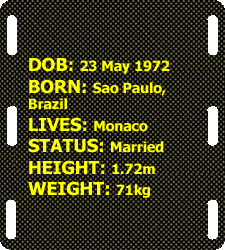
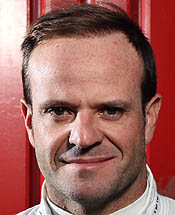
|
Rubens made his F1 debut with Jordan in 1993, and remains the team's longest serving driver.
A solid first season was marred by a string of technical failures, but Rubens went on to score his first points in Japan, finishing fifth.
1994 got off to a good start, with a fourth place in the opening race of the season followed by a first podium at Aida, but disaster was to strike at Imola.
A horrific Friday practice crash put Rubens out of the race, and was an indication of what was to come that fateful weekend. Barrichello's countryman Ayrton Senna was killed during the San Marino GP and Rubens found himself carrying the hopes of Brazil on his shoulders.
It was a heavy load to bear, and Rubens struggled at times throughout the remainder of the year. Retirements continued to plague his races with Jordan, and he eventually moved to Stewart in 1997, scoring an impressive podium at the Monaco GP where he finished second.
Barrichello's big break came in 1999 when he announced at the end of the year that he had signed to partner Michael Schumacher at Ferrari. Life with the Italian team got off to a perfect start for Rubens, who finished second in his first race for the team, but he was soon to discover the frustrations of being a number two.
Victory came in the 2000 German GP, and an emotional Barrichello sobbed his heart out on the top step of the podium.
Life at Ferrari was becoming difficult, and although Rubens was thanked for his part in helping the team achieve its two world championships, many insiders believed that the Brazilian's contract would not be renewed at the end of 2001, but it was.
Ferrari again had cause to celebrate in 2001, but Rubens was angered by the decision to make him move over for his team mate during the Austrian GP, adamant that he could give Schumacher a run for his money if it were not for team orders. That said, Rubens was unable to match the pace of his partner for much of the season and was actually under pressure from Coulthard and the WilliamsF1 drivers, eventually finishing third in the championship, albeit it with less than half the points scored by his team-mate. That said the Brazilian suffered some appalling luck and more than his fair share of retirements.
2002 began with a string of retirements due to technical problems, that never seemed to afflict Michael's car, and accidents. Ahead of the Austrian GP Rubens surprised everyone by re-signing with Ferrari for a further two seasons, but by the end of the weekend he was probably wishing he hadn't.
Despite starting from pole and leading for most of the race, Rubens was ordered to hand the victory to his team-mate just yards before the finish-line. The incident caused outrage in the media and many fans and insiders to wonder at the Brazilian's apparent lack of self-respect.
Rather than let its two drivers race, Ferrari issued team orders which favoured Schumacher, though the Brazilian was handed a couple of token wins.
Many will feel that 2003 was Rubens' best ever season, the Brazilian taking a couple of very convincing wins in Britain and Japan. On the other hand whilst Schumacher seemed never to suffer mechanical failures - during races at least - Barrichello suffered a number of high-profile failures.
Rubens' win in Japan was crucial for it secured Ferrari's fifth consecutive Constructors' Championship, somehow it seemed fitting that the Brazilian finally get his moment of glory having played such an important part in the team's revival.
Despite talk that Rubens would be dropped for 2004 in favour of fellow Brazilian Felipe Massa, he retained his seat for a fifth season.
In all honesty, Rubens is a frustrating driver, and one wonders how, in years to come, he'll look back on his F1 career, and in particular his time with Ferrari.
Certainly, he has been part of one of the most successful teams in the history of motorsport, but in many ways he's similar to Brad Dexter in The Magnificent Seven. Everyone remembers him, but its Yul Brynner, Steve McQueen, Charles Bronson, Robert Vaughn, James Coburn and even Eli Wallach, that everyone really remembers.
There were a few inspired moments for Rubens in 2004, not just the wins in Italy and China, but also qualifying at Indianapolis, when he out-paced his teammate, despite a heavier fuel load. However, for the most part it was business as usual, with Rubens playing support to the headline act.
There were many who hoped that in 2005, the popular Brazilian might step out of the shadows, and finally give Michael a fight, or at least be allowed to. That said, even though most F1 people are of the opinion that the German would beat his teammate nine times out of ten, the F2005, and Bridgestone, ensured that we never got to find out.
The season got off to a promising start when Rubens finished second to Giancarlo Fisichella in Australia, but in many ways this proved to be one of the year's highlights.
There were good finishes in Europe and Canada, but despite what the statistics say, Indianapolis is where it all went wrong. The Brazilian was still smarting from a last lap attack from his teammate in Monaco, a move that many would put down to the German's 'never-say-die attitude, but Rubens' believed was unnecessarily risky. Then came the near collision at Indianapolis, when, following his pit stop, Schumacher almost forced the Brazilian off track - this at a time when only six cars were racing.
A couple of months later, following weeks of rumours, it was officially confirmed that after six seasons, and nine wins, Rubens was leaving Ferrari and joining BAR, soon to be Honda.
Having lived in Michael Schumacher's shadow for so long it was unthinkable to believe that Rubens might opt to play a similar role to Honda's 'golden boy', Jenson Button. With a wealth of experience, and in (Sporting Director) Gil de Ferran, a close friend, when Rubens was recruited it was because he was a 'proven winner'.
It took the Brazilian some time to get used to the way things worked at Honda, not merely the company philosophy but also such things as the RA106's traction control.
In the early stages of the season there were times when it looked as though Rubens was totally out of his depth. He was regularly out-qualified by his teammate, and also trailing in terms of points.
It was at the Nurburgring that Rubens first out-qualified Button, coming home to finish fifth. Thereafter, the Brazilian appeared to gain confidence, and though he added to the Japanese team's points tally he suffered a string of engine failures.
Having qualified third in Hungary, ahead of his teammate who forfeited ten places having suffered an engine failure in free practice, Rubens was in with a chance of scoring his maiden win for the team, but it was not to be. Button, starting from fourteenth on the grid took his maiden Grand Prix win and Honda's first of the modern era.
Looking at end of season statistics one sees that although Rubens and Button out-qualified one another nine times, it was the Englishman who scored the Japanese team's only win of the season and gave it its only pole. Furthermore, the Brazilian trailed his teammate by twenty points in the Driver's Championship.
Nonetheless, Rubens retains his place in 2007, the second year of his two year deal.
In his final days at Ferrari it appeared that he had lost his sparkle, lost the edge, and gotten a little lazy. We said at the time that Honda, and a young-ish 'hot shot' like Button might be just what was needed to give the popular Brazilian a much needed kick up the arse, forcing him to demonstrate that he still has the hunger.
There were glimpses in 2006 when it appeared that he still retains the hunger, but they were all too brief. Like Giancarlo Fisichella, Rubens is a man for whom 2007 will be make or break.
On the basis of the final seven races of 2006, in which his team scored 54 points - only 10 less than Renault - Rubens must have thought that in 2007 he would add to his, and Honda's, tally of wins. He was wrong. For the first time in his F1 career, the Brazilian ended the season pointless, his best finish being ninth place at Silverstone.
The RA107, described pre-season by teammate Jenson Button as a "piece of shit", proved to be just that. However, whereas the Englishman managed to get into the points on three occasions, scoring an against all odds fifth in China, Rubens struggled with a car that wouldn't do what he wanted it to do, such was its woeful handling.
On only one occasion did the Brazilian make it into the final phase of qualifying, but this was Monaco, known for its freak results. In Hungary, where he qualified eighteenth, the Brazilian was left for dead by Adrian Sutil in the Spyker.
Whereas many thought the Brazilian might retire, or even be dropped by Honda at the end of the year, Rubens was retained for 2008, partnering Button for a third successive season.
The good news for the Brazilian was that he would be reunited with former Ferrari Technical Director Ross Brawn who joined the Brackley outfit in late 2007. The bad news was that the Englishman arrived too late to have any significant impact on the 2008 car.
It was another poor car, not helped by the fact that the Honda powerplant was now among the least powerful on the grid. As Brawn and the team opted to write off the season, focussing all their efforts on the 2009 car, Rubens was determined that he would be around for the new car and therefore set about doing the best he could with the banger that was the 2008 version.
Having been overshadowed by Button in 2007, the situation was reversed a year later, with Barrichello scoring the majority of the team's points and generally giving a good account of himself.
His season got off to a good start in Melbourne where he finished fifth. However, he was subsequently disqualified for jumping the red light at the end of the pitlane.
While most statisticians - including Pitpass - dispute it, Rubens claimed that the Turkish Grand Prix marked his 257th F1 race, beating the long-held record of Riccardo Patrese. However, there was little else to celebrate that day as he finished fourteenth, one lap down on the leaders. At Monaco however, and again in Canada he scored points, at one point leading the Montreal race courtesy of an unscheduled appearance by the Safety Car.
The highlight of the season however, had to be Silverstone, where a shrewd choice of tyres saw Rubens visit the podium for the first time since Indianapolis 2005.
The were further strong performances in Singapore and Japan, but for the most part he was struggling, the RA108 clearly not up to the job.
He finished the season in fourteenth position, and while many believed the Brazilian had raced his last Grand Prix, others weren't so sure.
With the news on December 5 that Honda was to quit F1 it appeared that Rubens long career in F1 might indeed be at an end, especially with claims in the media that Bruno Senna - who tested for the Brackley team at the end of 2008 - was being backed by a consortium preparing to buy the team.
Rubens remained quiet, avoiding the press as much as possible, but when Honda announced that the team had been sold to Ross Brawn and the Englishman confirmed an unchanged line-up, the Brazilian could conceal neither his joy nor his frustration.
"People said I was done, that nobody wanted me," he wrote on his website. "There was one who wrote that Bruno Senna had already signed for three years with the team, an absurd story where the desperate (reporter) tried to get a beat without having any basis or source.
"The important thing is that during this period of hard times I kept my faith, worked my body hard and kept quiet, speaking only to the team's personnel.
"To say that I was sure when I declared at the Brazilian GP that that race was not my last one would be too much," he admitted, "but something told me it wasn't."
Although Brawn only participated in two tests before the season opener in Melbourne the out-of-the box pace was astonishing. By the time the grid lined in Australia the opposition had closed the gap but not enough to prevent the Brackley team scoring a 1-2 at the first attempt.
While Rubens performed well, fully justifying Brawn's decision to retain him, Button was outstanding taking six victories in the first seven races.
Watching the Briton build his championship lead some pointed to Rubens and claimed that the Brazilian was doing what he'd done at Ferrari, playing the role of faithful support to the team leader. However, while the veteran didn't have the pace of his English teammate it wasn't long before he was wondering if there was more to the situation than met the eye.
By the time of the Spanish GP, Rubens was openly questioning the team claiming bias towards his teammate, a move that Ross Brawn treated with masterful diplomacy. It happened again in Germany but once again the English veteran was on hand to calm the situation.
As it happens, while Button dominated in the first half of the season, it was Rubens who had the edge in the second. From the British round onwards it was clear that the BGP 01 struggled in cooler temperatures, however, the Brazilian proved more able to deal with the problem than his teammate.
Victories at Valencia and Monza - his first wins since 2004 - allowed Rubens to close the gap to his teammate, however, 11 points from the final four races meant it was not to be, with the Brazilian ultimately finishing third in the championship.
While there had been much doubt as to whether Rubens would secure a drive in 2009 there was no such problem going in to 2010 with Williams confirming the Brazilian as its number one on the day after the Abu Dhabi GP.
Out of the box the FW32 wasn't too bad, better than the much-anticipated Force India and even a little better than the Renault. While Force India had slipped behind by Valencia, Renault, which had its F-duct in place by Hungary, lefts its Grove rival pretty much for dust in the second half of the season.
The team had opted for a shorter gearbox and wheelbase, thereby compromising diffuser performance, while it was also the only Cosworth customer that opted to build its own gearbox hydraulics.
At the season opener, Rubens was unable to make the cut into Q3 and starting from eleventh on the grid brought his FW32 home in tenth opening his points account with Williams in his first outing. While he finished eighth in Australia, having stalled on the grid in Malaysia (overheating clutch) he was unable to make it back into the points.
An aero upgrade at Barcelona proved somewhat ineffective, Rubens, having qualified a lowly eighteenth, subsequently benefited from Lewis Hamilton's late crash and snatched ninth.
At Monaco, a great start saw him up to sixth (from ninth) going into Ste Devote, however, later in the race he crashed heavily after his suspension collapsed after hitting a loose manhole cover. While one sympathised with the Brazilian, who had looked good for a strong points finish, his behaviour in throwing his steering wheel out of the car and on to the track was pathetic.
There were further problems in Turkey and Canada. At Istanbul, Rubens suffered an overheating clutch on the grid and immediately dropped to the back of the field. A poor pit stop later in the race only compounded his misery. In Montreal, his anti-stall system kicked in at the start dropping him back through the field once again. Although he made a good recovery, he later collided with Jaime Alguersuari when the Spaniard unexpectedly moved across to cover his line, the damage incurred blocking the FW32's left brake duct.
The Grove outfit had been losing out as its rivals introduced their versions of the F-duct. In terms of the blown diffuser, Williams had actually led the way with its development however, it opted not to use it from the start of the season because it didn't have the capacity to build different exhaust layouts. When the team finally ran the device (at Valencia) it was trouble free and effective, and by Silverstone it was clearly making a real difference to the FW32.
Rubens was proving to be a real inspiration to the team, and responded to the developments introduced in Valencia with a brace of good qualifying and race results, finishing fourth in the European Grand Prix and fifth in Britain.
In Hungary, Rubens was involved in a great scrap with his former teammate Michael Schumacher. As the pair fought for tenth place, the German moved across on Rubens almost forcing him into the pit wall. It was a move that caused outrage in the media, in the paddock and on message boards. It was a move for which Schumacher was given a ten-place grid penalty for the next race, the Belgian GP, ironically, Rubens' 300th F1 race.
Sadly, a momentous day in Rubens' long career turned out to be something of a damp squib, the Brazilian - who just before the race had been elected chairman of the Grand Prix Drivers' Association - collided with Giancarlo Fisichella on the very first lap.
Benefiting from a new front wing in Singapore, Rubens responded by qualifying sixth, his best performance of the season thus far. Despite losing out to Robert Kubica and Nico Rosberg, the Brazilian was able to hold on to sixth in the race next day.
There were further points finishes in Japan and Korea before heading off to his home race at Interlagos. Having never enjoyed success back home, Rubens will have felt either buoyant or thoroughly hacked off when teammate Hulkenberg took pole, the German youngster providing one of the few true shocks of the season. While Nico was at least able to claim eighth in the race, a collision with Alguersuari was to cost Rubens any hopes of scoring a point.
Poor strategy following the Liuzzi/Schumacher incident in Abu Dhabi saw Rubens miss out on any hope of a points finish, the German ending his eighteenth season in F1 tenth in the standings tied with Adrian Sutil.
In 2010, Rubens proved that there was still plenty of life in the old dog, he certainly wasn't making up the numbers. As if proof were needed, the day after the season finale, Williams confirmed that the Brazilian veteran had been retained for another campaign.
When Pastor Maldonado was confirmed as Rubens' teammate, the first time since 1981 that the British team hadn't featured a European driver in its line-up, the alarm bells should have started ringing, No disrespect, but it was the Venezuelan's financial backing as opposed to his on-track talent that clearly attracted the Grove outfit.
Then came the debacle that was the float on the Frankfurt Stock Exchange, not a bid to raise funding to improve the team but a means of increasing the size of Patrick Head's pension pot.
Despite all the warning signs, nothing prepared Rubens, race fans or probably even Williams themselves for what was to follow, arguably the worst season in the team's long, illustrious history.
While in some areas the FW33 was quite innovative, the team devoting much of its resources to its low-line gearbox, it lagged behind in terms of the blown diffuser. Other than a lack of outright pace, the FW33 suffered from poor reliability, witness the fact that it wasn't until the third race (China) that both cars actually finished and even then were placed thirteenth and eighteenth. As for points, the first of those didn't come until Monaco, Rubens bringing his car home a distant ninth.
No doubt, Rubens hopes were raised in Jerez in pre-season testing when he topped the timesheets after three days. However, when it really mattered, once the season got underway, everything fell apart.
Not once did the Brazilian make it through to Q3 and surprisingly only out-qualified his rookie teammate ten times. On race day he usually managed to get to the finish, but only twice into the points.
Though consistent, as ever, his vast experience counted for little, the FW33 was a dog and everyone knew it.
Emotional as ever, a couple of times he openly criticised his team and one has to say that his apparent joy at seeing Sam Michael replaced by Mike Coughlan appears a little premature.
To add salt to an already gaping wound, for his home Grand Prix - and what might well prove to be his final Grand Prix - he could only qualify last, though at least he was able to bring the car home fourteenth next day.
There is no doubt that Rubens remains highly motivated and his experience, he has taken part in more Grands Prix than any other driver in the history of the sport, should be invaluable.
As early as the Japanese GP, reliable sources were telling Pitpass that Rubens had been retained for a third season. However, the shock news that AT&T had opted to end its relationship with Williams at year end pretty much threw everything into the air.
In early January, with the first launches just a few weeks away, Rubens, Bruno Senna, Adrian Sutil and Vitaly Petrov are all being considered for the Williams seat, with the size of their backing very much being taken into consideration.
Romantics want to see the Brazilian veteran return for a record twentieth season, however, as Bernie Ecclestone will readily tell you, F1 has no place for sentimentality.
Statistics - at the end of 2011 Season
Drivers' Titles: 0
Seasons in F1: 19
Grand Prix: 322
Wins: 11
Poles: 14
Fastest Laps: 17
Best result in 2011: 9th (2 times)
Best qualifying 2011: 11th (Turkey)
Worst qualifying 2011: 24th (Brazil)
2011: Out-qualified Pastor Maldonado 10 times
2011: Out-qualified by Pastor Maldonado 9 times
2011: Completed 1030 out of 1133 laps (90.9%)
2011: Finished 16 times from 19 starts (84%)
|